
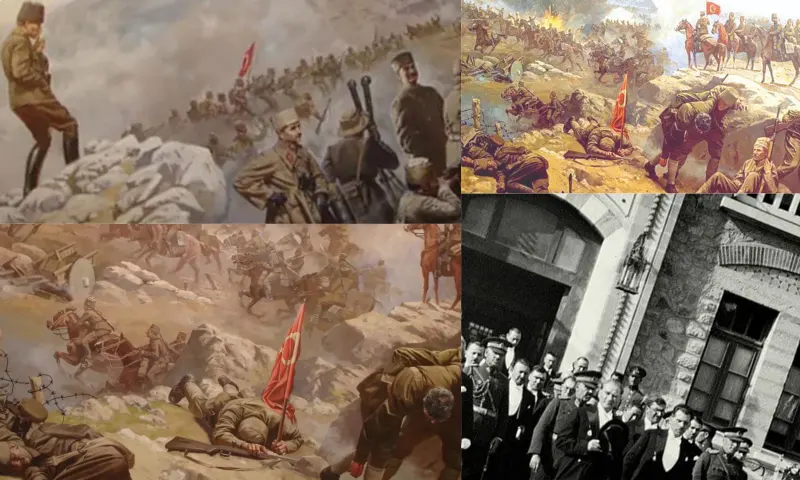
The Situation Before the War of Independence
After World War I, the Ottoman Empire had reached the brink of collapse. The vast empire, which had stood for 6 centuries, was now awaiting occupation by the Europeans. The Ottoman Empire had already been going through very difficult times before World War I. It had become clear that the Ottoman Empire would collapse after the Russo-Turkish War of 1877-1878. The European imperialist powers were doing their best to carve out territories from the Ottoman Empire. After the Russo-Turkish War, which saw the Ottoman Empire fight against the Russians, it endured very serious wars such as the Greco-Turkish War, the Balkan Wars, the Italo-Turkish War, and World War I. These wars had brought the Ottoman Empire to the verge of collapse. It had become certain that the state would disintegrate, especially after World War I. After the war, the Ottoman Empire expected a treaty from the Europeans. A peace treaty was supposed to be signed after the Armistice of Mudros, signed with the Entente powers. The Entente powers were determined to confine the Ottoman Empire to Anatolia. However, the people and the army would not allow this. They believed that the state had been defeated, but the people had not yet been defeated. In this direction, the people began to unite under the name of Kuvayi Milliye. Kuvayi Milliye units were small military groups consisting of 50-100 people from the populace. Their aim was to prevent enemy soldiers from entering their regions. Furthermore, some Ottoman Pashas had not disbanded the armies under their command. The armies were not dispersing; on the contrary, they were being strengthened. Some of these Pashas were Ali Fuat Pasha and Kazım Karabekir Pasha.
The Beginning of the War of Independence
Mustafa Kemal Pasha, who had analyzed the situation thoroughly and had been present on the Caucasus, Palestine, and Çanakkale fronts during World War I, planned to go to Samsun and take charge of the organized populace. In this regard, he held 8 meetings with Sultan Vahdettin. Sultan Vahdettin also found it suitable for Mustafa Kemal Pasha to go to Samsun. After all, he was the most suitable Pasha in the Capital. Sultan Vahdettin gave Mustafa Kemal 25,000 gold coins to successfully carry out his mission. This amount was enough to buy one-tenth of Istanbul at that time. On May 19, 1919, Mustafa Kemal set out for Samsun on the Bandırma Ferry, with the titles of Honorary Aide-de-Camp to the Sultan and Inspector of Anatolia. Upon arriving in Samsun, Mustafa Kemal paved the way for a new resistance. His aim was to raise awareness among the organized populace against the occupations and to establish a new government. In this direction, the Erzurum Congress was held on July 23, 1919, and the Sivas Congress was held on September 4, 1919. Before these congresses were convened, the Greeks had occupied Izmir on May 21, 1919. The occupation of Izmir was an expected event. The Entente powers had notified the Ottoman Government of the impending occupation of Izmir one day in advance.
The Beginning of the Occupations and the People's Resistance
After the occupation of Izmir, the people began to fight against the enemy with greater determination. Mustafa Kemal Pasha and the Ottoman Pashas with him knew that they could not achieve victory against the enemy with only Kuvayi Milliye units. They could not receive help from the state due to the Ottoman Government falling into the hands of the traitorous Damat Ferit Pasha. Sultan Vahdettin had appointed Salih Pasha, a Turkist Pasha, to head the government. After becoming Grand Vizier, Salih Pasha began to staff the new cabinet with Pashas who did not tolerate the occupations. The British, realizing this situation, began to pressure the Sultan to change the Grand Vizier. In this regard, Damat Ferit was reinstated to his former position. Damat Ferit's return to the position of Grand Vizier led to the British gaining the government to their side. This also led to the death sentences issued against the Pashas during the War of Independence and the policy of supporting the occupations. The Ottoman Pashas, knowing that the Sultan was under pressure in Istanbul, established a new Grand National Assembly in Ankara on April 23, 1920. This assembly ensured the systematic prevention of occupations. Mustafa Kemal Pasha was later appointed to head the assembly. The Pashas who had a say in the new assembly were Mustafa Kemal Pasha, İsmet Pasha, Kazım Karabekir Pasha, Ali Fuat Pasha, Fevzi Pasha, Nurettin Pasha, and Ali Pasha. These Pashas were the ones organizing the resistance from all four corners.





